
What is a Hex bolt?
23th October 2026Hex means 6 (just like hexagon, which is a shape with 6 sides). A hex bolt has a six-sided head, which allows it to be tightened or loosened. Sockets and wrenches are common tools used to tighten or loosen it.
A hex bolt, also known as a hex-head bolt, is one of the most common types of fasteners found in automobiles, machines, construction, and many other applications.
Parts of a Hex Bolt
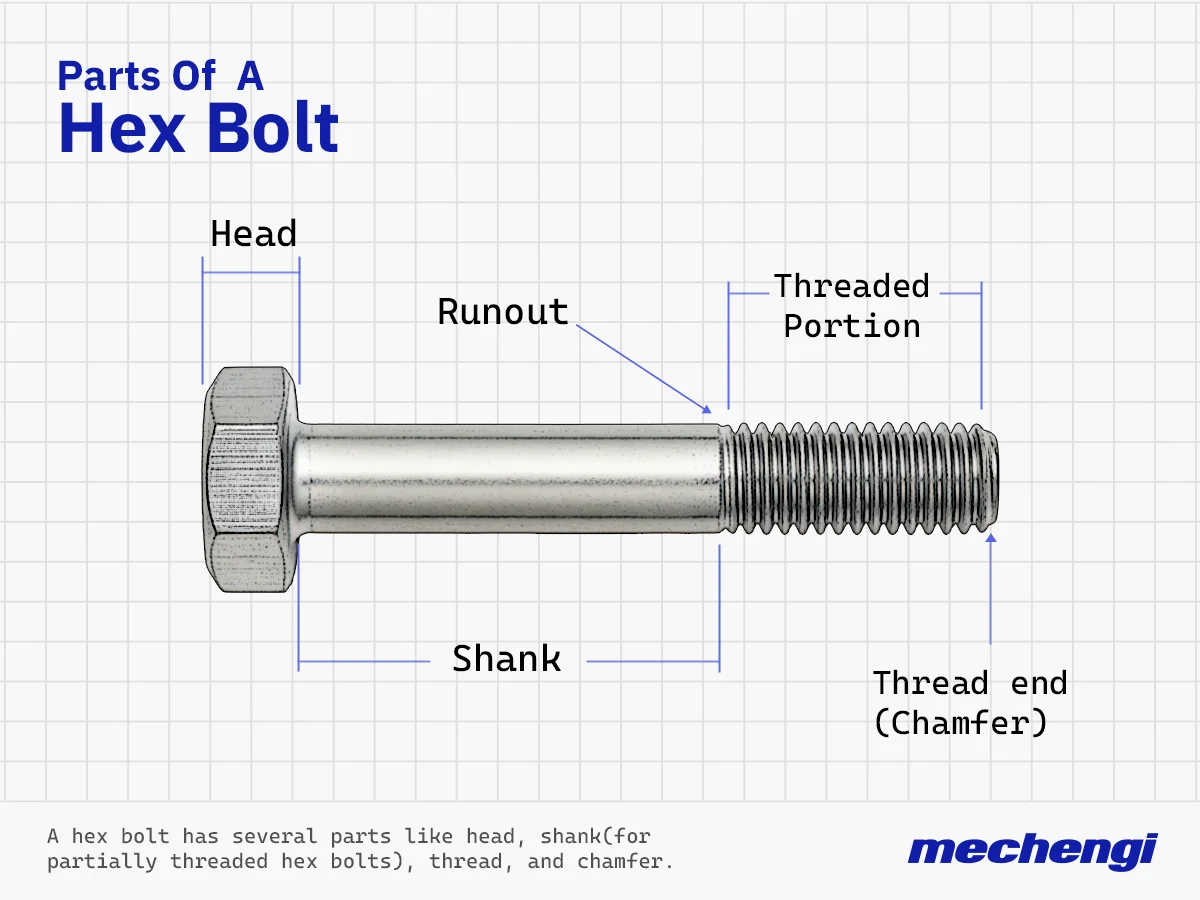
A hex bolt has several important parts:
Head: This is the six-sided part of the bolt that provides a gripping surface for tools used to tighten or loosen the bolt (torque application). It may also have grade markings on the top. The head also prevents the bolt from rotating while it is being tightened.
Bearing Surface: This is the flat surface on the underside of the head. It provides a smooth contact area and distributes the clamping force over the surface. It can also help prevent damage to the surface when the bolt is tightened.
Shank: This is the smooth, unthreaded portion of the bolt. Its main functions are to provide alignment and, in applications designed for it, carry shear loads. A fully threaded bolt has threads extending along the entire specified length, so it does not have a conventional unthreaded shank.
Threaded Portion: This is the portion of the bolt with threads. It engages with a nut or a threaded hole. Its main function is to pull the connected parts together and generate clamping force.
Thread End (Chamfer): This is the end of the bolt where the threads terminate. It is usually slightly chamfered to make nut installation easier, help with alignment, and protect the first thread from damage.
How Does a Hex Bolt Work?
A hex bolt does not simply hold the entire load by itself. When a bolt is tightened, it creates tension in the bolt, known as preload. This tension pulls the connected parts together and creates a compressive force between them, as shown in the figure below.
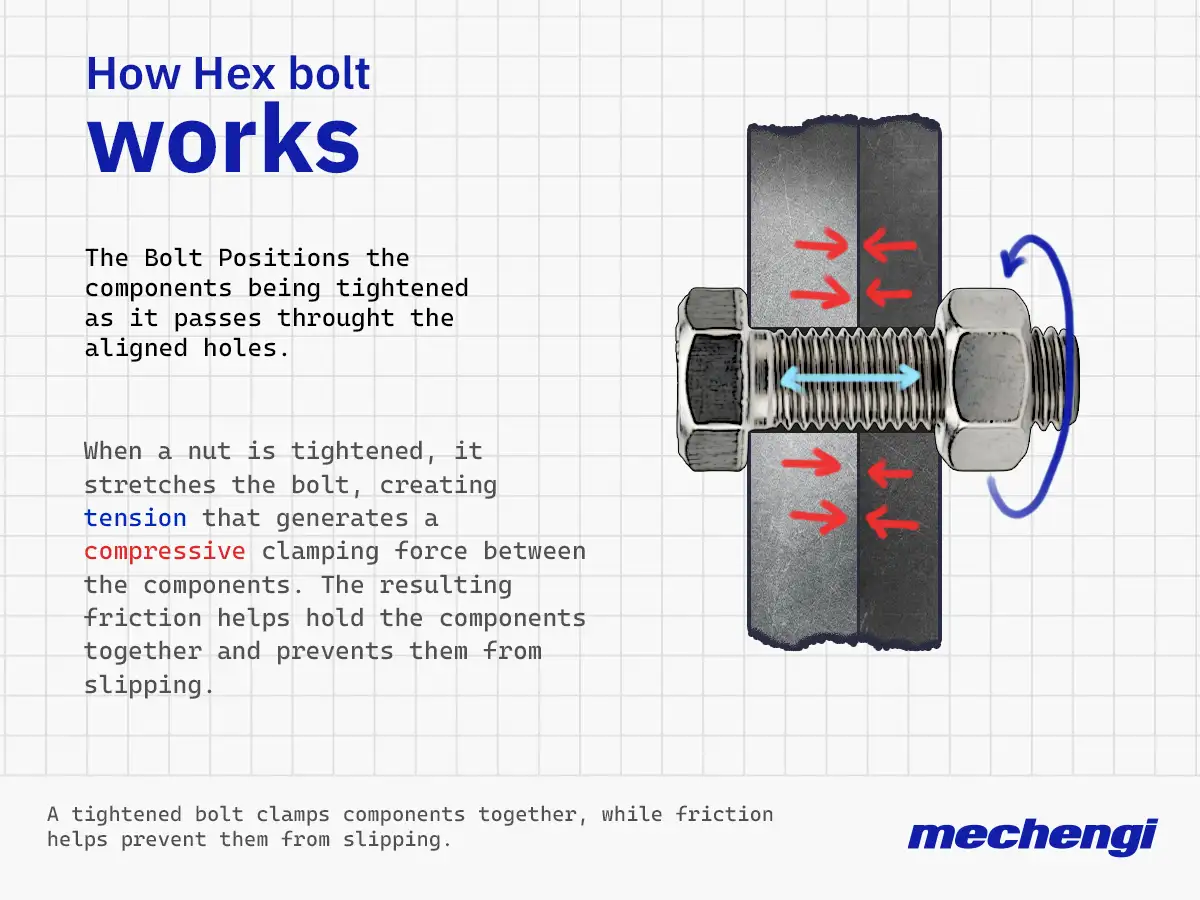
The compression between the joined parts creates friction at the joint interface. This friction helps prevent the parts from sliding relative to each other. In a properly designed and tightened joint, this friction can carry a significant portion of the operating loads, reducing the load that would otherwise be carried directly by the bolt.
Fully Threaded vs. Partially Threaded
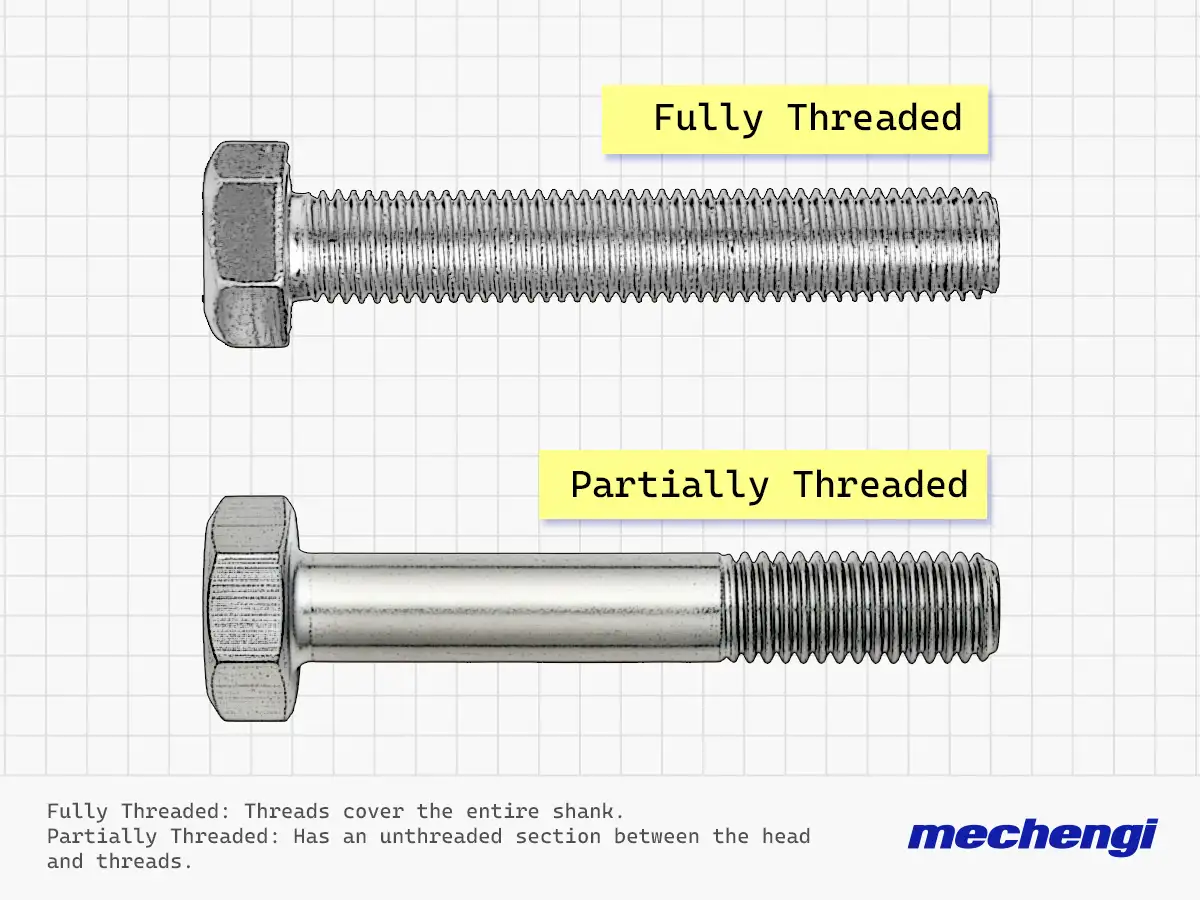
Fully Threaded
A fully threaded bolt has threads extending along the entire length of the shank, up to the head. The absence of an unthreaded shank allows the bolt to accommodate a wider range of material thicknesses and provides more flexibility when adjusting the clamping position.
However, if the threaded portion lies within the shear plane, the threads can reduce the effective shear area because the thread root has a smaller diameter than the unthreaded shank. This can make a fully threaded bolt less suitable for certain shear-loaded applications.
Partially Threaded
A partially threaded bolt has an unthreaded shank between the head and the threaded portion. The smooth shank provides a larger, continuous cross-sectional area and can provide better resistance to shear when the shear plane passes through the shank.
Partially threaded bolts can also provide better alignment and reduce wear in applications where the smooth shank fits closely within a hole. They are commonly preferred for certain structural and shear-loaded joints, provided the bolt is correctly sized and installed.
Types of Threads
There are two main types of threads:
Coarse Thread: Has a larger thread pitch and is generally used for common fastening applications. It allows faster assembly and is less prone to cross-threading and thread damage during installation.
Fine Thread: Has a smaller thread pitch and provides finer adjustment. It can also provide better resistance to loosening caused by vibration in some applications and is useful where precise adjustment or higher thread engagement is required.
Materials
Hex bolts are commonly available in the following materials:
- Carbon Steel (Most common, strong and cheap)
- Stainless Steel (Corrosion resistant)
- Alloy steel (Higher strength)
- Brass (Decorative, corrosion-resistant & non-magnetic)
- Titanium (Extremely Light & Higher strength)
Surface finishes
Hex bolts can have different coatings or surface finishes. Some common finishes include:
- Uncoated (Plain)
- Zinc Plated
- Black Oxide
- GEOMET / Zinc-Flake
- Hot-Dip Galvanized
- Phosphate Coated
Surface finishes are mainly used to improve corrosion resistance, provide a desired appearance, reduce friction, or control the friction characteristics of the threads and bearing surfaces.
Strength Grades
Hex bolt strength is commonly specified using two systems: the SAE Grade System, which is commonly used for inch-series (imperial) bolts, and the Metric Property Class System, which is used for metric bolts according to ISO standards. These grades or property classes indicate the mechanical strength of the bolt, such as its tensile strength and yield strength
| Grade | Tensile Strength (Mpa) | Typical use |
|---|---|---|
| 4.6 | 400 | Light duty |
| 5.8 | 500 | General Purpose machinery |
| 8.8 | 800 | Automotive and industrial machinery |
| 10.9 | 1000 | Heavy-Duty mechanical Joint |
| 12.9 | 1200 | High performance machinery and tooling |
Example: Consider a bolt having a strength grade of 8.8
-
The first number multiplied by 100 gives the nominal tensile strength:
Tensile Strength: 8 × 100 = 800 MPa
-
The second number represents the ratio of the nominal yield strength to the nominal tensile strength. Therefore:
Yield strength: 0.8 × 800 = 640 MPa
Reading a Hex Bolt
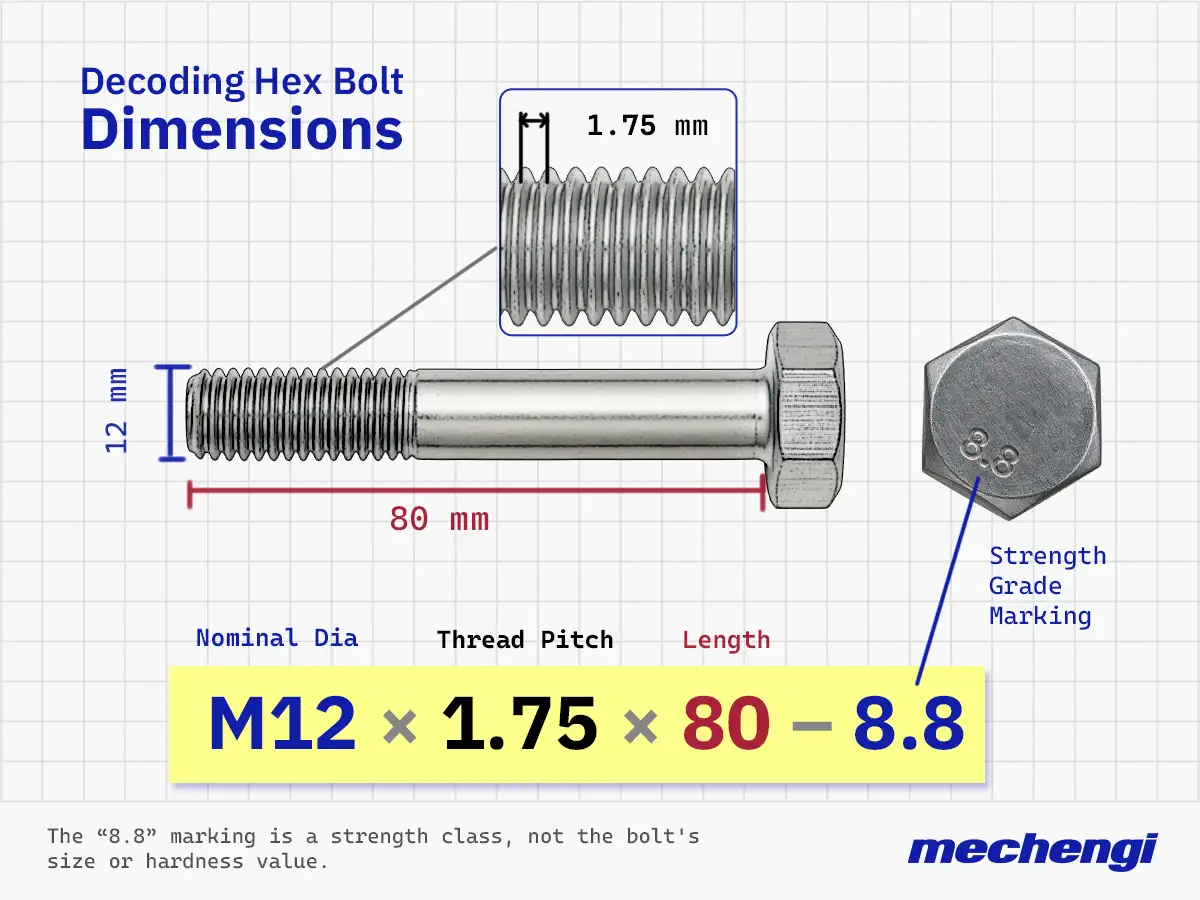
Let me explain this with an example.
Consider a bolt with the specification M12 × 1.75 × 80 – 8.8.
Here:
- M12 – Indicates that the bolt has a nominal thread diameter of 12 mm.
- 1.75 – Indicates the thread pitch, which is the distance between two adjacent threads. In this case, the pitch is 1.75 mm.
- 80 – Indicates that the bolt length is 80 mm.
- 8.8 – Indicates the metric property class of the bolt. It has a nominal tensile strength of 800 MPa.
Advantages
- Easy to tighten with common tools.
- It has High strength
- Available in many sizes and grades
- Standardized worldwide
Limitations
- Require sufficient space for the socket or the wrench to install.